The Simulated Patient Will See You Now: Six Predictions for Medical Education Through 2028
Medical Education · · 5 min read

On October 27, the AAMC published its first national AI competencies across the learning continuum. It’s a quiet milestone, but it marks a shift. The question for medical education is no longer whether AI belongs in training. It’s how. And AI is already moving into curricula fast: the share of US and Canadian MD and DO schools incorporating it rose from 53% in 2023 to 77% in 2024, according to the AAMC.
AI patient simulation is where the “how” gets concrete. A realistic patient encounter no longer needs a room, an actor or a calendar slot. The research literature on it has grown sharply in the past year. Here’s where we think it goes over the next 24 months: less science fiction, more practical change.
A Tuesday night in late 2028
Maya, a second-year PA student, is on her fourth chest pain case of the week. It’s 10:40 p.m. Her patient, speaking in a tired voice, keeps steering the conversation toward his reflux, and he’s mildly annoyed she’s asking about his father’s heart attack. She pulls up his ECG, orders a troponin and formulates a working diagnosis.
The feedback that comes back isn’t just a score. It highlights how she initially anchored on a GI diagnosis, only broadening her differential as additional diagnostic data became available. The next morning, her advisor sees that a third of the cohort is doing the same thing, and rewrites the day’s small group around it.
None of this needs a breakthrough. Most of Maya’s night is already possible in Sapient Clinician. What the next two years will bring is that it becomes ordinary, and that brings changes most programs aren’t planning for yet.
Six predictions
1. Clinical reasoning gets its own “game film”
Today a learner might get a handful of standardized patient encounters before a high-stakes OSCE. Within two years, many will run dozens a term, on their own schedule. The bigger change is what gets recorded: not just the diagnosis, but what they asked, what they skipped and when they reached a diagnosis. Learners will review their reasoning the way athletes review game film.
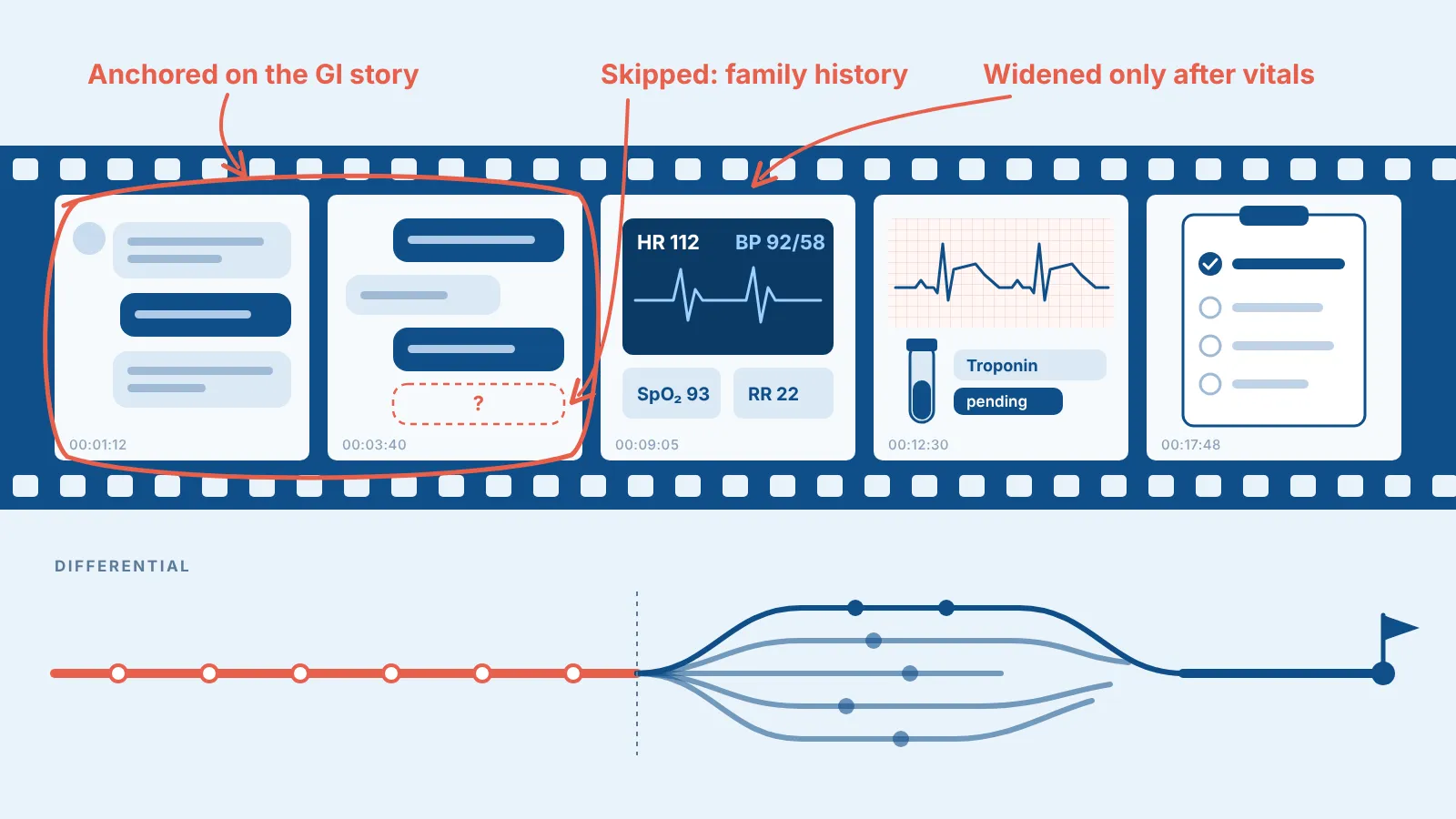
Early evidence is encouraging. A 2026 study from Karolinska Institutet found that AI-generated feedback after virtual patient encounters improved students’ performance on a later OSCE-based assessment.
2. The patients get harder, in the right ways
Most research so far focuses on history-taking, a recent review notes. That’s the easy part. The next wave will push into what’s hard to stage with actors on a schedule: the patient who downplays symptoms, the family member who interrupts, the conversation held through an interpreter, the case that only makes sense once you look at the image.
3. AI becomes the second rater, not the judge
Researchers are now testing how closely AI scoring matches faculty ratings, from voice-based virtual patient platforms to OSCEs. We expect AI to settle into the role of a consistent, tireless second rater for providing formative feedback. Faculty will keep the focus on high-stakes judgment. That fits naturally with competency-based education and entrustable professional activities (EPAs), which need far more observations than faculty can currently provide.
4. The faculty role shifts toward case author and coach
As routine feedback scales, faculty time moves elsewhere. Two skills will gain value. The first is creating cases: turning a memorable patient into a reusable simulated encounter that reflects a program’s own population and specialty. The second is reviewing cohort data: spotting that a third of the class closes on a diagnosis too early, while there’s still time to adjust. Expect faculty development in both areas to become standard. The AAMC’s new competencies already set expectations for educators, not only learners.
5. Simulation centers get redesigned, not replaced
When the University of Nebraska Medical Center piloted an AI simulated patient case, learners valued the clinical reasoning feedback. Their opinions on replacing traditional OSCEs were mixed. That’s probably the right instinct. AI encounters will take on the repetition. Programs can prioritize standardized patient experiences for competencies that benefit most from human interaction, such as hands-on physical examination and nuanced communication, including non-verbal cues. The best programs will rebuild their simulation programs to accommodate both.
6. Simulation becomes where learners practice working with AI
This may be the least expected change. Clinicians will practice with AI tools at their side, from ambient scribes to diagnostic assistants. Yale is already studying how an AI scribe affects student notes in an OSCE. A simulated encounter is a safe place to learn when to trust the tool, when to question it and how to keep your own reasoning switched on. Simulations that ask learners to reason first and consult AI second could become a practical answer to worries about deskilling.
What has to go right
None of this happens automatically. Three things will separate programs that produce better reasoners from ones that just log more cases:
- Earn trust in the assessment. Reviews of AI-based clinical assessment agree that the evidence on reliability across different learner groups is still thin. The programs that pilot carefully, comparing AI and human standardized patients side by side, will shape the standards everyone else adopts.
- Grade the reasoning, not just the answer. A simulation that scores only the final diagnosis just recreates the multiple-choice problem with a friendlier interface. Meaningful feedback should highlight how learners gathered information, identified relevant findings and arrived at their clinical decisions.
- Keep faculty in charge of content. AI patients can still say things a real patient wouldn’t know, or get facts wrong. Faculty should review and approve assigned cases to ensure consistency in content and presentation across learners.
The next two years are a design choice
AI patient simulation will spread through medical education either way. What’s still to be determined is whether it produces clinicians who reason better, or just clinicians who completed more cases. That depends on what educators choose to measure now, and on how they spend the time it gives back.
At Sapient Clinician, we’re committed to working through these questions and making this future a reality. If you’re experimenting with AI simulation in your program, or deciding whether to, we’d like to hear what you’re seeing. Reach out and compare notes with us.