Realistic AI patients for practice and assessment
Learners build clinical reasoning and communication skills through full patient encounters. You write the cases, and every encounter is scored on your rubric.
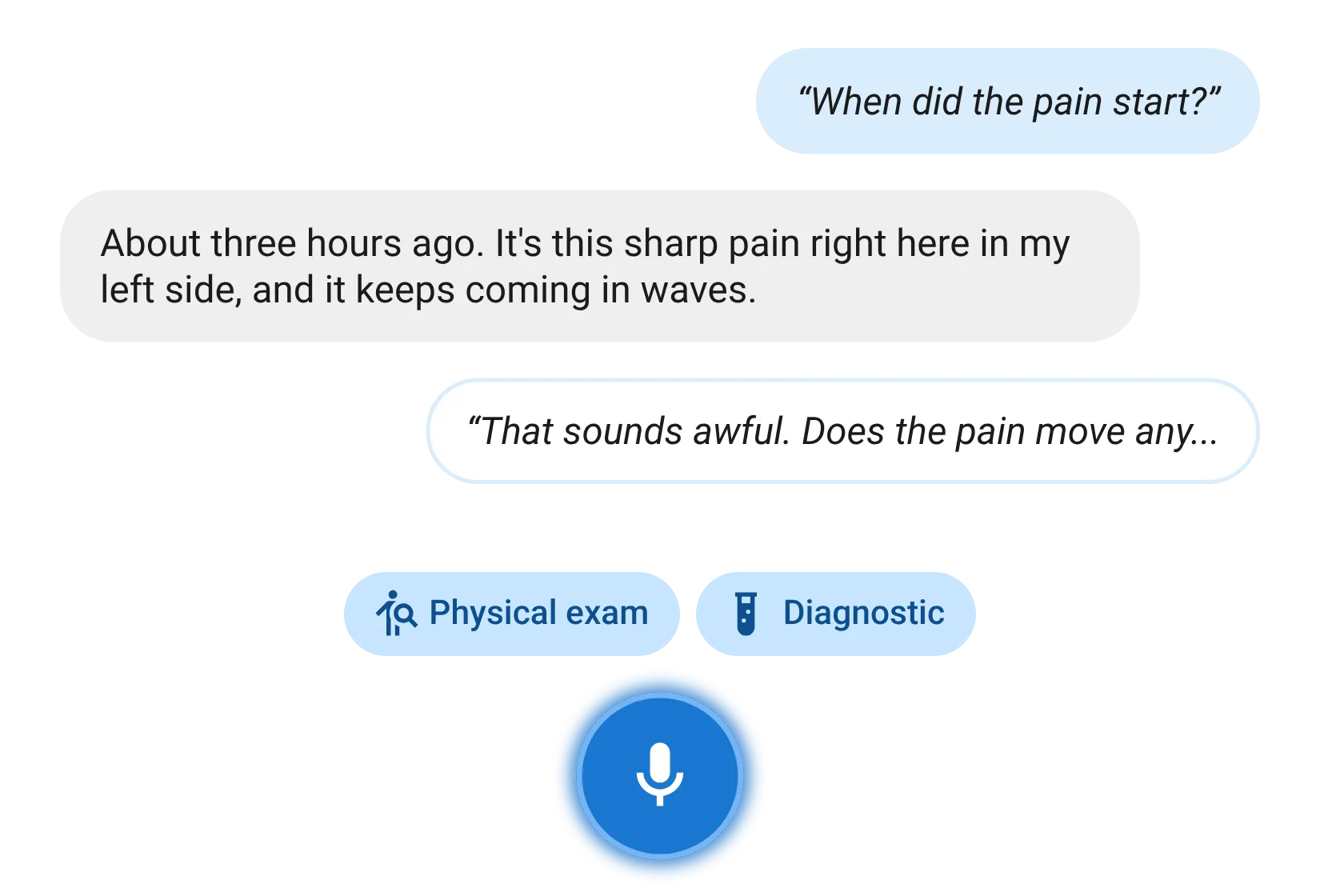
An example encounter: the learner asks an AI patient about a pain in his left side and orders a test, saying what they expect it to show.
AI-powered patient simulations.
Learners work through a complete encounter with a realistic AI patient, by text or voice. They take a history, perform a physical exam, order diagnostics and create an assessment and plan, just as they would with a real patient.
It works anytime, on any device.
Fully custom cases, built around your curriculum.
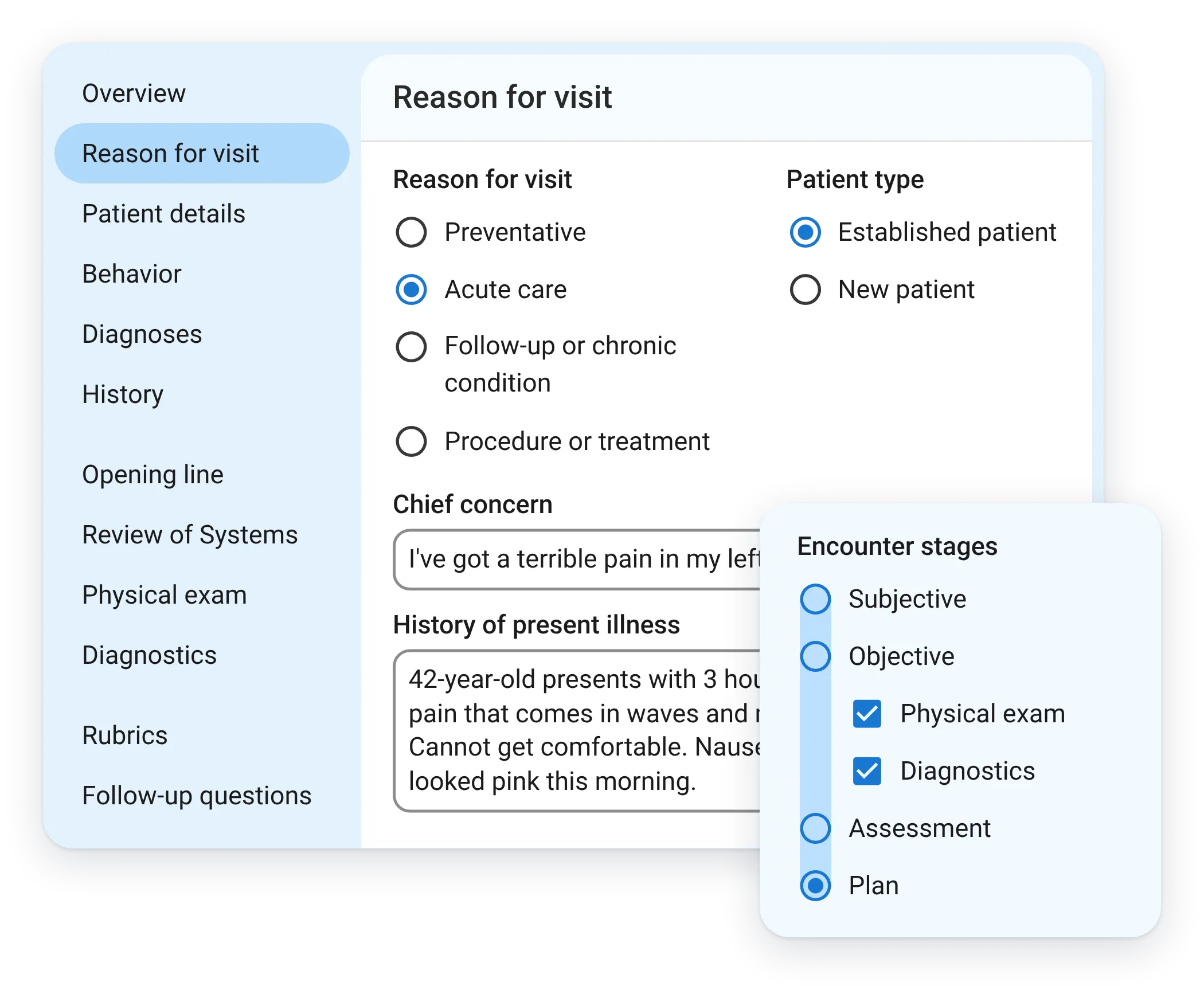
Build a case for exactly what your learners need to practice, in any specialty or presentation. Upload the case files your SPs already use, or start from a guided form.
AI drafts the findings and results in minutes, and you approve every detail.
See how they think, not just where they land.
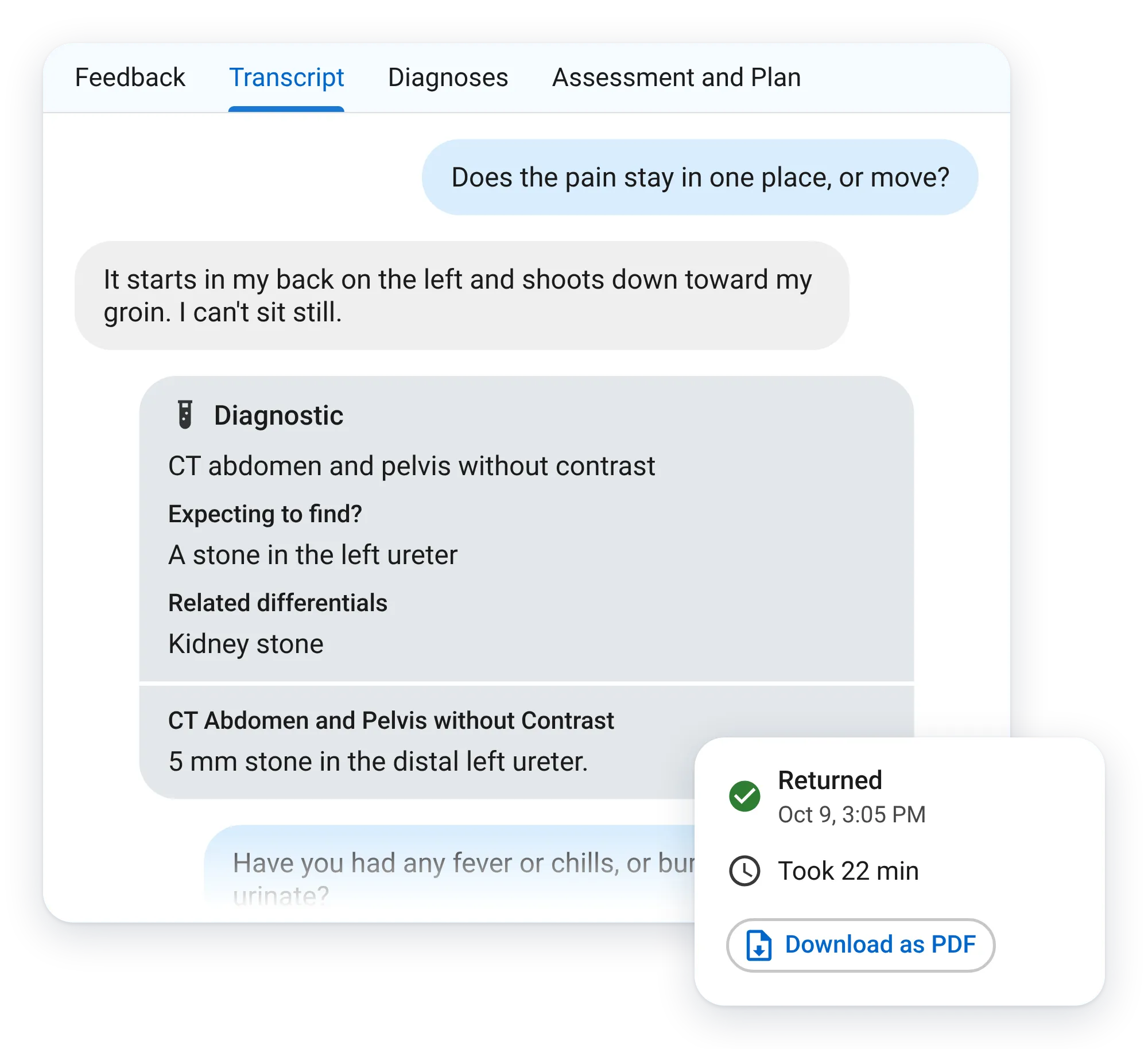
Exams show what a learner concluded. The transcript shows how they got there.
Every encounter is recorded from the first question to the final plan: what they asked and why, what they examined and ordered, how their thinking changed as results came in, and what they never considered.
Detailed, actionable feedback using your rubric.
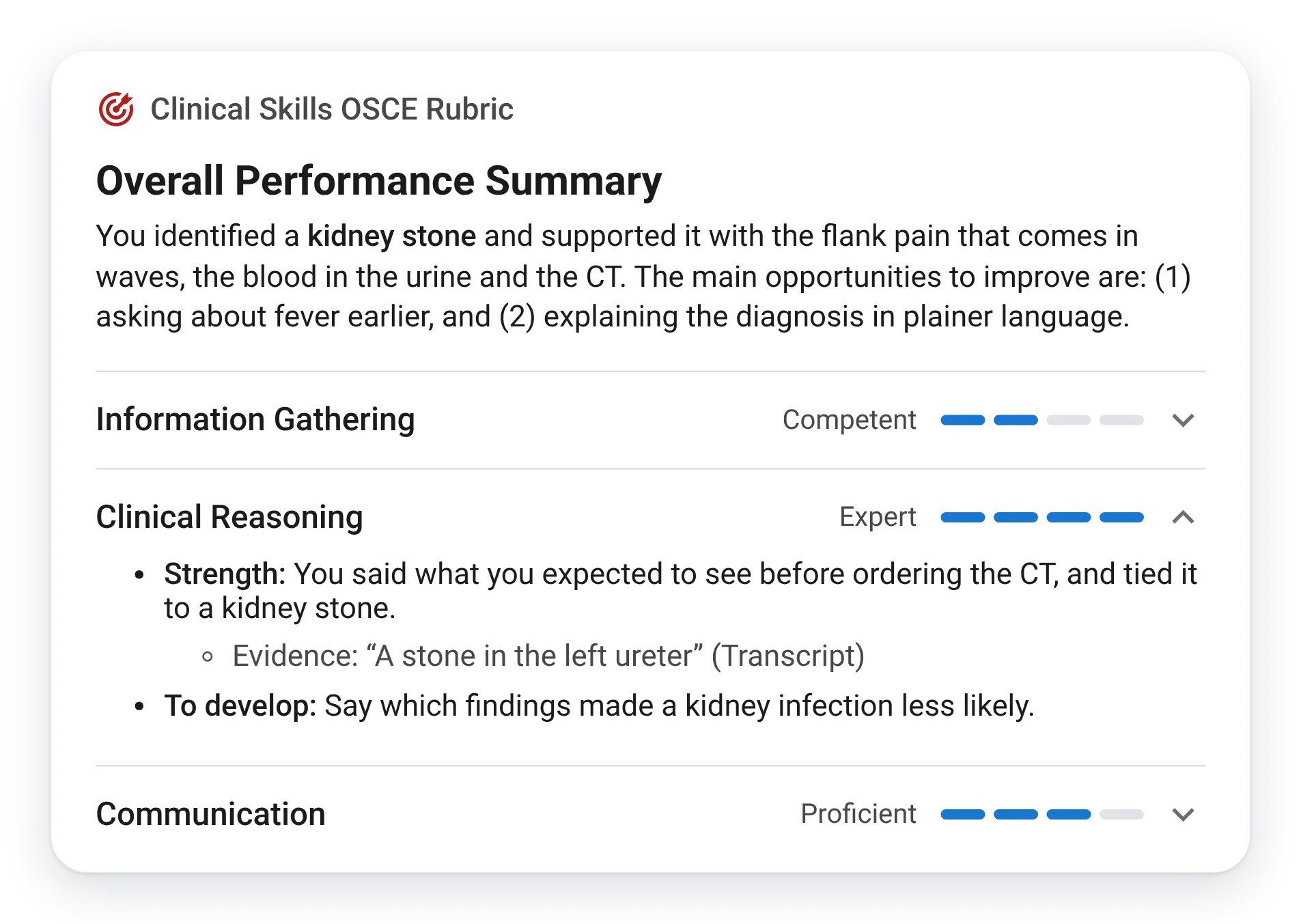
Upload your program's rubric. Every encounter is scored on it, with specific strengths and gaps tied to moments in the transcript, so learners know exactly what to work on next.
Use it where your program needs it most.
-
Practice & assessment
Use any case for low-stakes practice or as a scored assessment.
-
Remediation
Focused practice built around the exact gap a learner needs to close.
-
Communication skills
Hard conversations learners can practice, with feedback on how they communicate.
-
Supplementing OSCEs & SPs
Lower SP costs, and more practice than OSCEs allow.
Built for every kind of program.
-
PA programs
More patient encounters before the clinical year.
-
MD programs
Clinical reasoning practice from the first year on.
-
DO programs
The osteopathic encounter, structural exam included.
-
Nursing & NP
NP diagnostic reasoning, plus prelicensure practice.
-
Residency & fellowships
Cases built into every rotation.
-
Health systems
Onboarding and ongoing training for clinicians.
AI that builds skills, not dependence.
Relying on AI for answers risks never-skilling in learners and deskilling in practicing clinicians. With Sapient Clinician, AI plays the patient, and the learner does the thinking.
Learners do the thinking.
They gather the history, choose what to examine and order, and commit to a plan themselves.
Faculty stay in control.
Educators approve every case they assign and choose when feedback is released.
Your data stays yours.
Patients are simulated, and your content and learners' work are never used to train AI.
What students are saying.
"Simulating a physical exam and interpreting the results makes it a much more realistic, end-to-end patient encounter."
"Being able to practice out loud with the AI patient helped me calm my nerves going into the in person OSCE's."
"Having to justify our reasoning and decisions with Sapient Clinician feels medically deeper than other AI patient simulation tools."