
PA programs
More patient encounters before the clinical year.
Give PA students frequent, realistic practice with feedback on how they reason — not just what they conclude — on your program's own cases and rubrics.
A few ways PA programs use it.
During the didactic year
Weekly cases tied to what students are learning now, so clinical reasoning starts before rotations do.
Before practical exams
Rehearse full encounters out loud, so the OSCE isn't the first time a student works a case from start to finish.
Remediation
Repeatable, truly standardized cases for students who need more practice — without scheduling another SP.
Evidence for the move from didactic to clinical.
ARC-PA standards already call for frequent, objective and documented evaluations to catch deficiencies early, and a summative evaluation that verifies competencies like clinical reasoning.
Every Sapient Clinician encounter leaves a documented record: the full transcript, scores on your rubric and specific feedback. That gives faculty real evidence for progress reviews and readiness conversations, well before the clinical year starts.
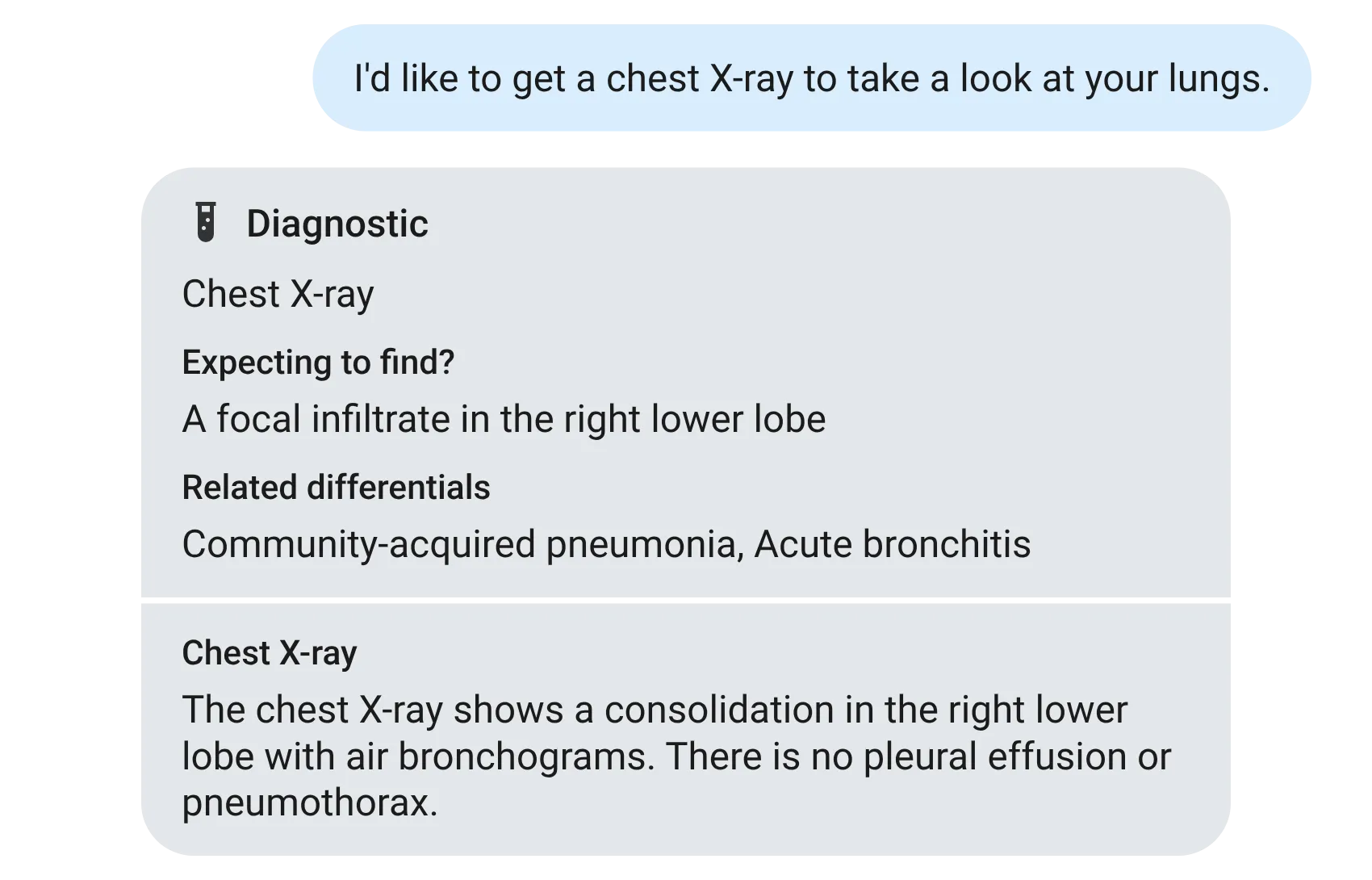
Every order comes with a reason.
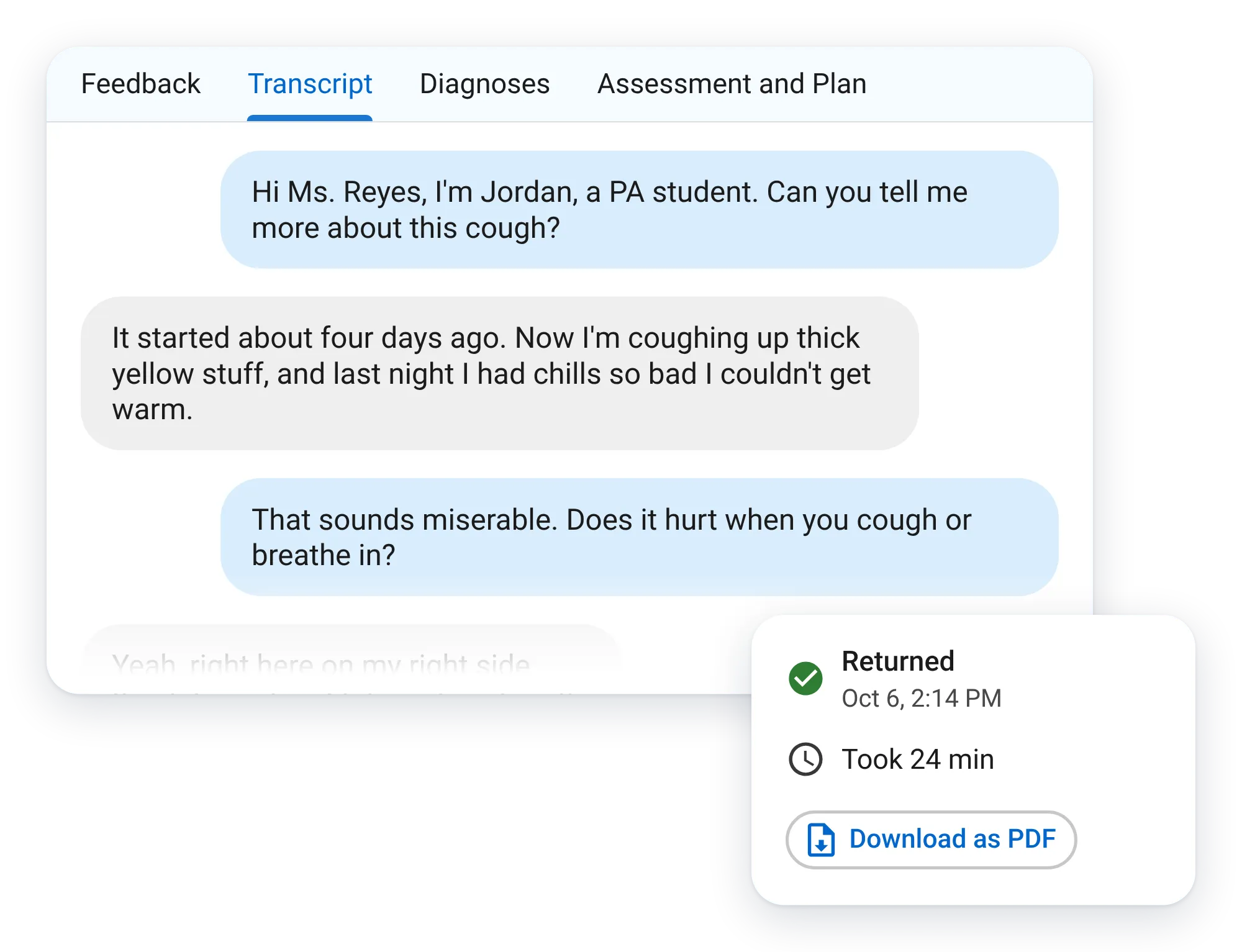
Students work the whole encounter in their own words, by voice or text, from the history and physical exam to diagnostics, a differential and a plan.
Before each test, they say what they expect to find and which diagnoses it relates to, so faculty see the reasoning behind every order and the plan it led to.
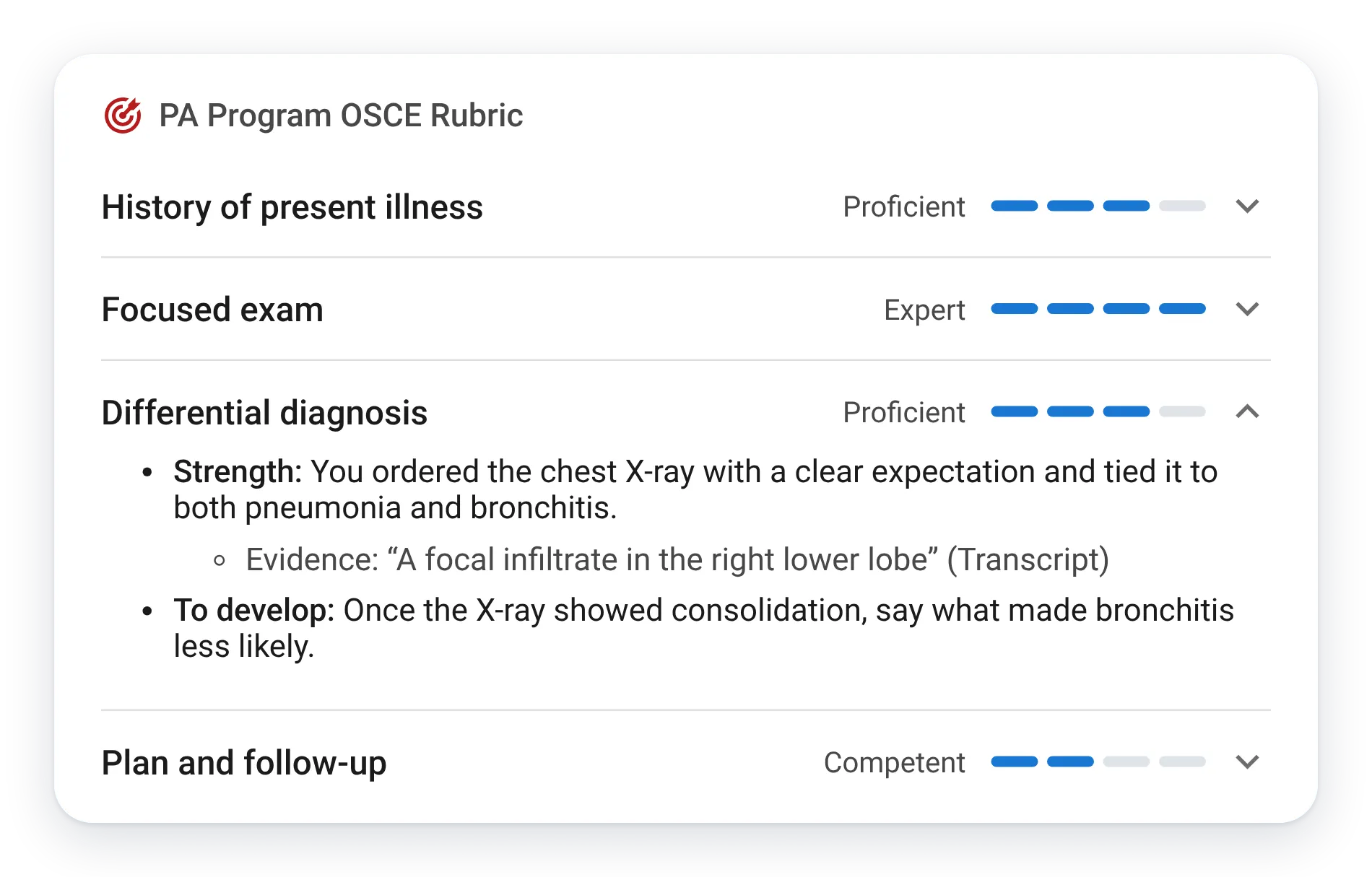
Scored on your rubric, with feedback after every case.
Upload your program's OSCE rubrics, including ones mapped to your program competencies, and every encounter is scored on them.
Students get specific feedback tied to what they actually said and did, and faculty can open the full transcript behind every score.
How it works for PA programs.
-
Full encounters
Students work the whole visit by text or voice, from history and physical exam to diagnostics, a differential, and an assessment and plan.
-
Your cases
Turn the cases your SPs already use into AI patient encounters, or build new ones around your didactic curriculum in about 15 minutes.
-
Your rubrics
Score on your program's OSCE rubrics, including rubrics mapped to your program competencies, with specific feedback after every case.
Designed by people who train PAs.
Our Chief Medical Officer, Diana Brewer, PA-C, has more than 20 years in clinical practice and medical education and directs an APP fellowship. Sapient Clinician is built around what she needed as an educator: a clear view of how each student reasons.
What PA students are saying.
"Sapient Clinician is a platform that makes a real difference for students who are struggling to finish PA school."
"Some of the other patient simulation platforms I have tried have patients responding with medical terminology like the pain is in my upper right quadrant, that is not how real conversations go or how patients communicate with their providers."
"Being able to practice out loud with the AI patient helped me calm my nerves going into the in person OSCE's."
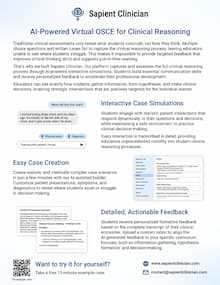
Share with your team
Sapient Clinician overview
What it is, how it works and where it fits, for colleagues or your curriculum committee.