
Unscripted patient encounters, from hello to plan.
Learners talk with an AI patient by text or voice, examine them, order tests, call for help and commit to a plan — with no fixed path, so they can make realistic mistakes.
A patient who talks like a patient.
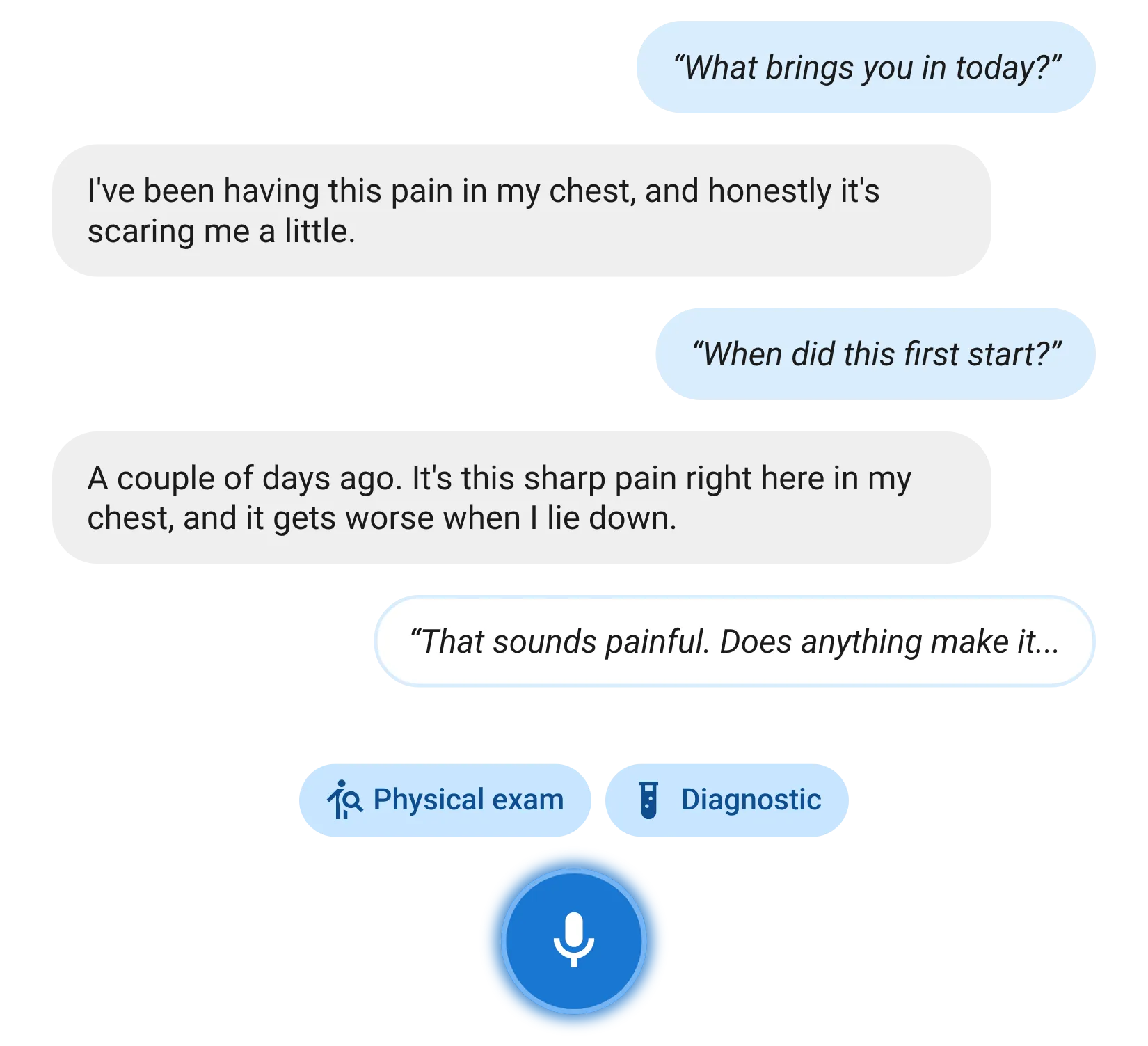
Learners type or speak naturally, and the patient answers in everyday language, describing symptoms in their own words rather than in textbook terms. Like a real patient, they only share what they're asked, so a learner who skips a question misses the answer.
Ask anything and the patient responds, while staying on script. Everything you write into the case stays fixed for every learner. Details you didn't write are filled in on the fly, always consistent with the diagnosis, so learners can't break the case by going off-road.
You set how the patient behaves, too: anxious, guarded, chatty, in pain, from a particular background. In voice mode, realistic AI voices respond with emotion, so learners practice the conversation out loud.
The whole encounter, not just the interview.
Cases follow the shape of a real visit, from the first question to a plan. Learners decide what to ask, examine and order, in whatever order they choose.
-
Subjective
History
Chief concern, HPI, past medical, family and social history, review of systems.
-
Objective
Physical exam
A routine exam, then focused follow-up tests.
-
Objective
Diagnostics & imaging
Labs, imaging, ECGs and more, with results in real time.
-
Assessment & plan
Commit to a plan
A final diagnosis and plan, the way they'd write it up.
Differential diagnosis · added to and revised throughout the encounter
A physical exam that tests decisions.
A virtual patient can't be touched, so the exam focuses on what learners choose to examine and why.
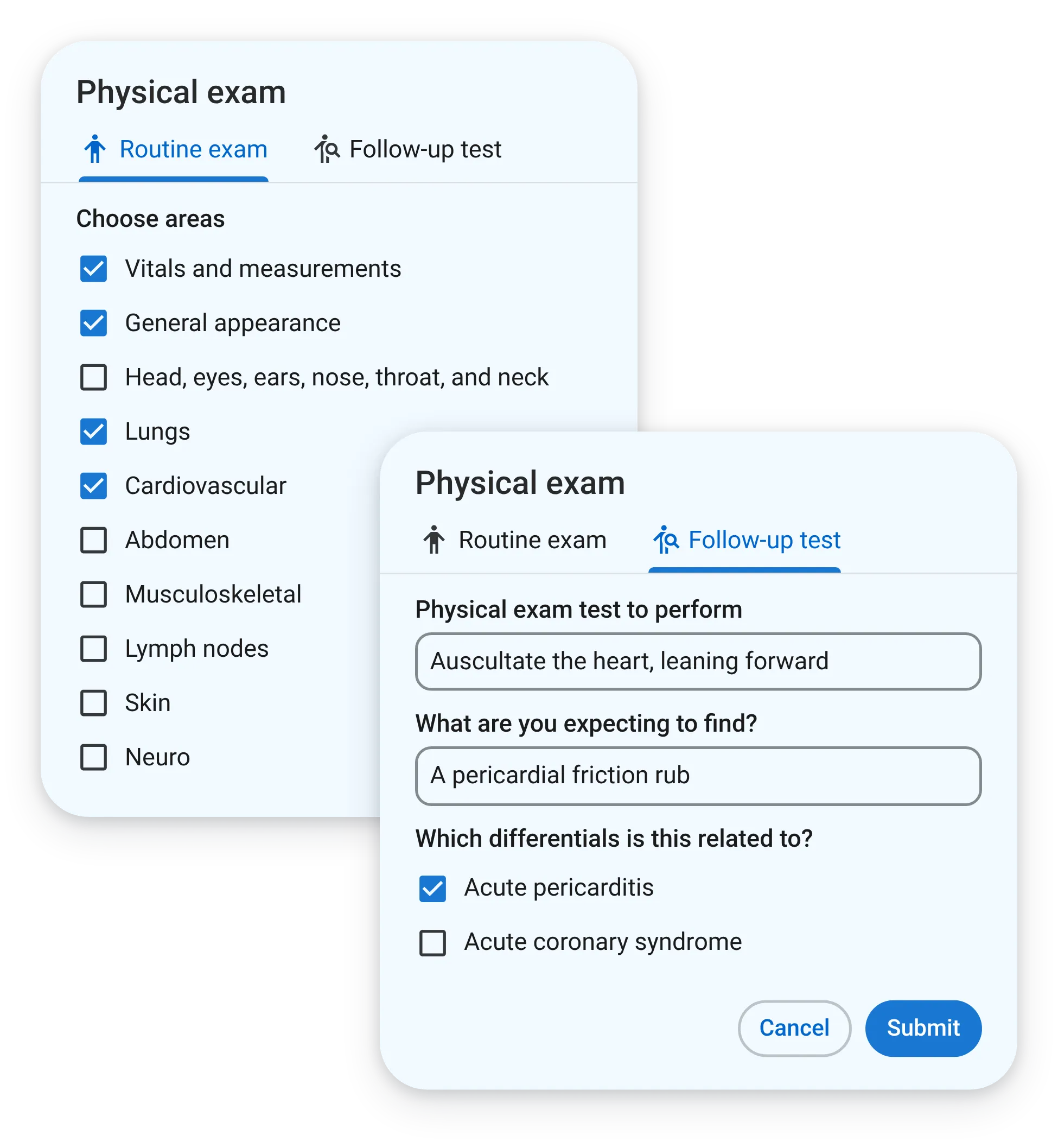
- Routine exam: learners pick the areas to check, such as vitals, general appearance, heart and lungs, and get the findings you wrote.
- Follow-up tests: they ask for specific maneuvers, like McBurney's point tenderness. Anything you didn't write is generated to fit the case.
- Findings can be text, or images you add, like a rash or a fundoscopic view.
Order what you'd order. See what you'd see.
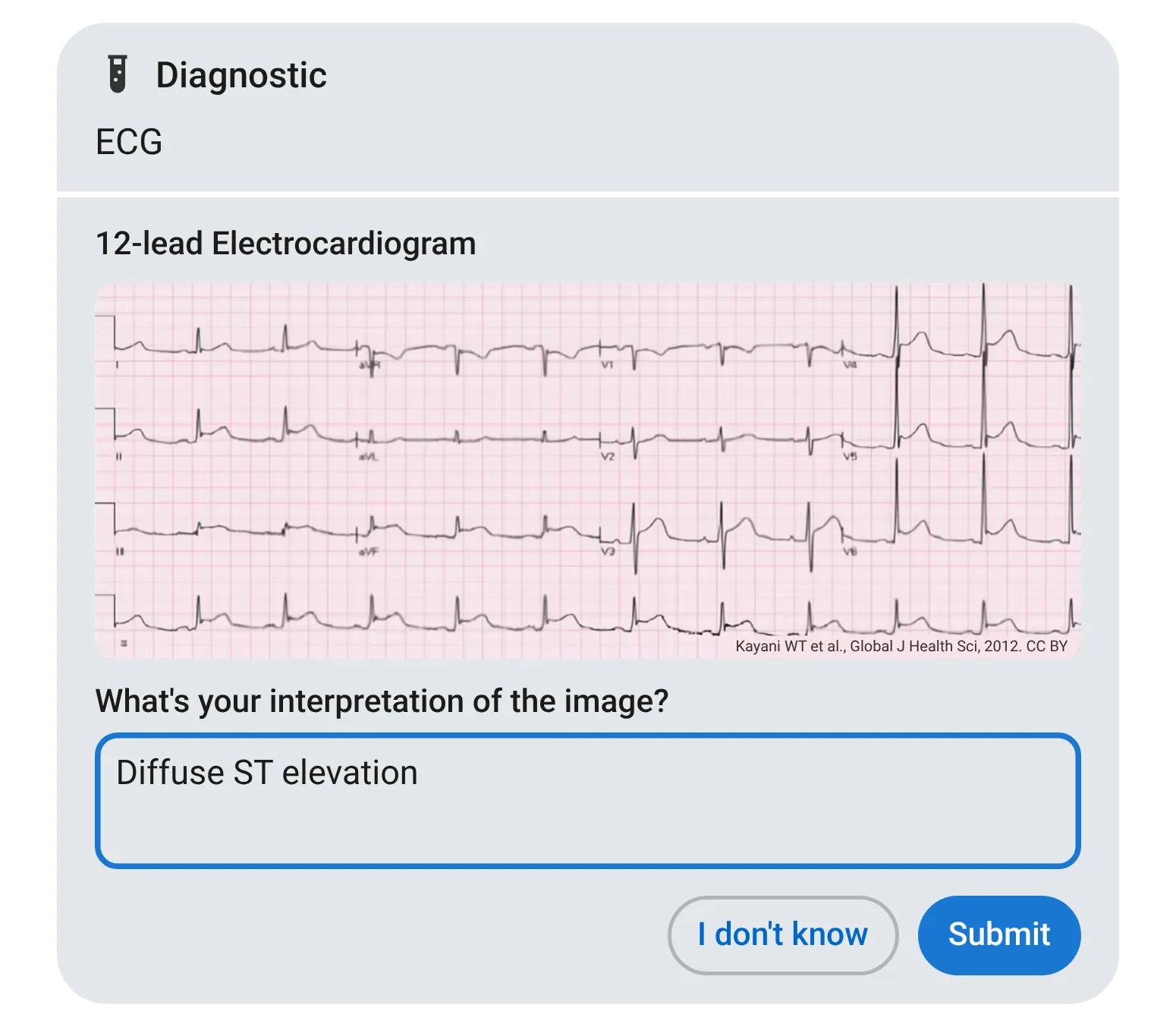
Labs, imaging, ECGs, cultures: learners can order any test, whenever they think it's warranted, and results come back in real time. Results you've written come back exactly as written; anything else is generated to fit the diagnosis.
When interpretation is part of the skill, add the actual image, like a chest X-ray or an ECG strip, and let learners interpret it themselves.
See how they think, not just where they land.
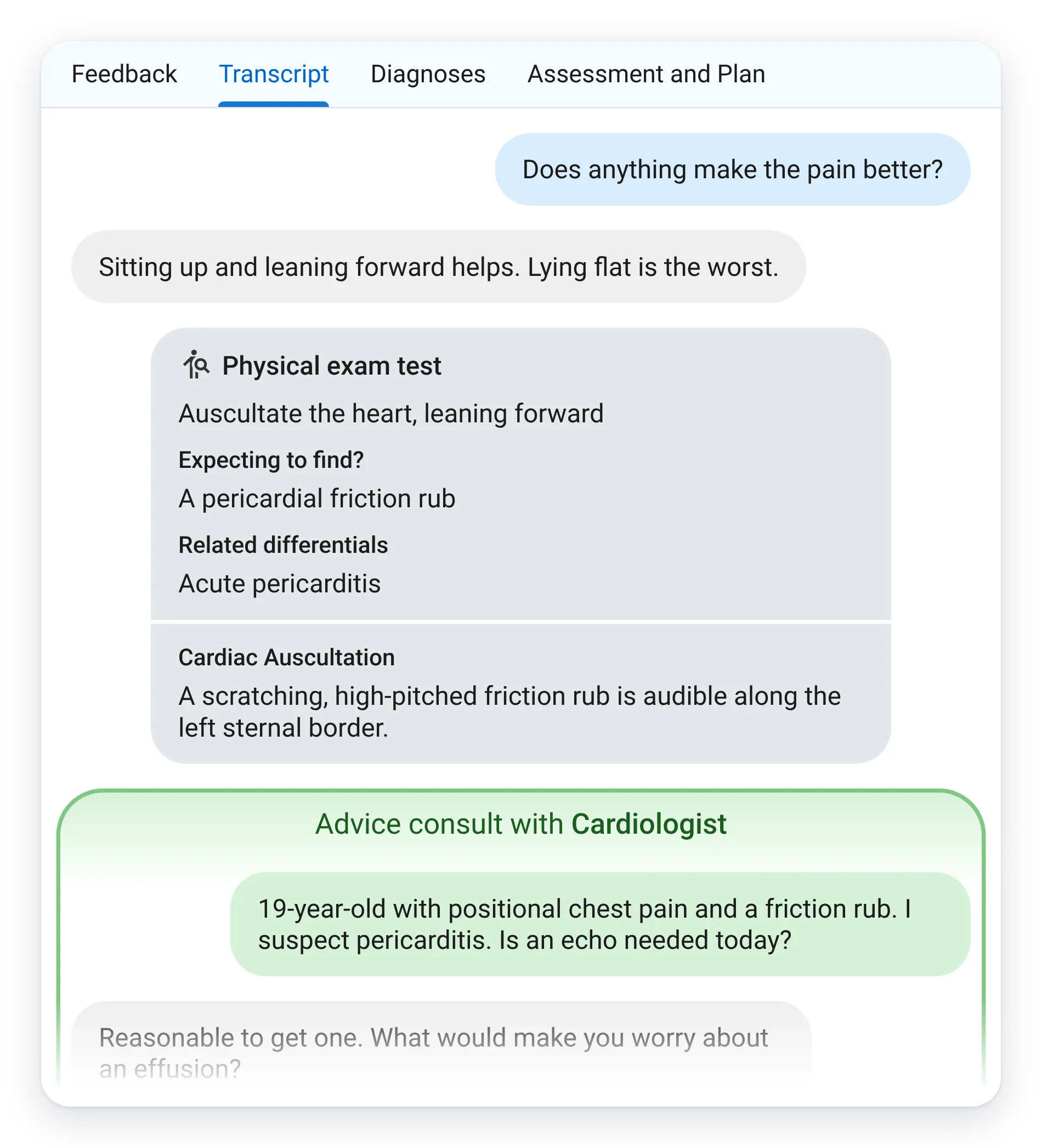
Every encounter produces a transcript that records more than the conversation. Each exam test and order shows up with what the learner expected to find and which differentials it relates to, right next to the result.
That makes the reasoning process easy to follow: which hypotheses drove each decision, whether results changed their thinking, where they narrowed too early, and what they never considered. The transcript ends with their assessment and plan, and feedback is scored on the same record.
As focused or as complete as you need.
Turn parts of the encounter on or off for each case, from a history-taking exercise for first-years to a full visit that ends with the learner explaining the plan to the patient.
History taking
A first-year interviews a patient with three weeks of fatigue.
Focused workup
Right lower quadrant pain: a targeted history, a few key exam maneuvers, and a differential before any imaging.
Full diagnostic encounter
Chest pain from the first question to an assessment and plan, with an ECG, troponin and a chest X-ray to interpret.
Closing the loop
Diagnose new-onset type 2 diabetes, then explain the diagnosis, answer the patient's questions and agree on next steps.
The conversations that are hardest to role-play.
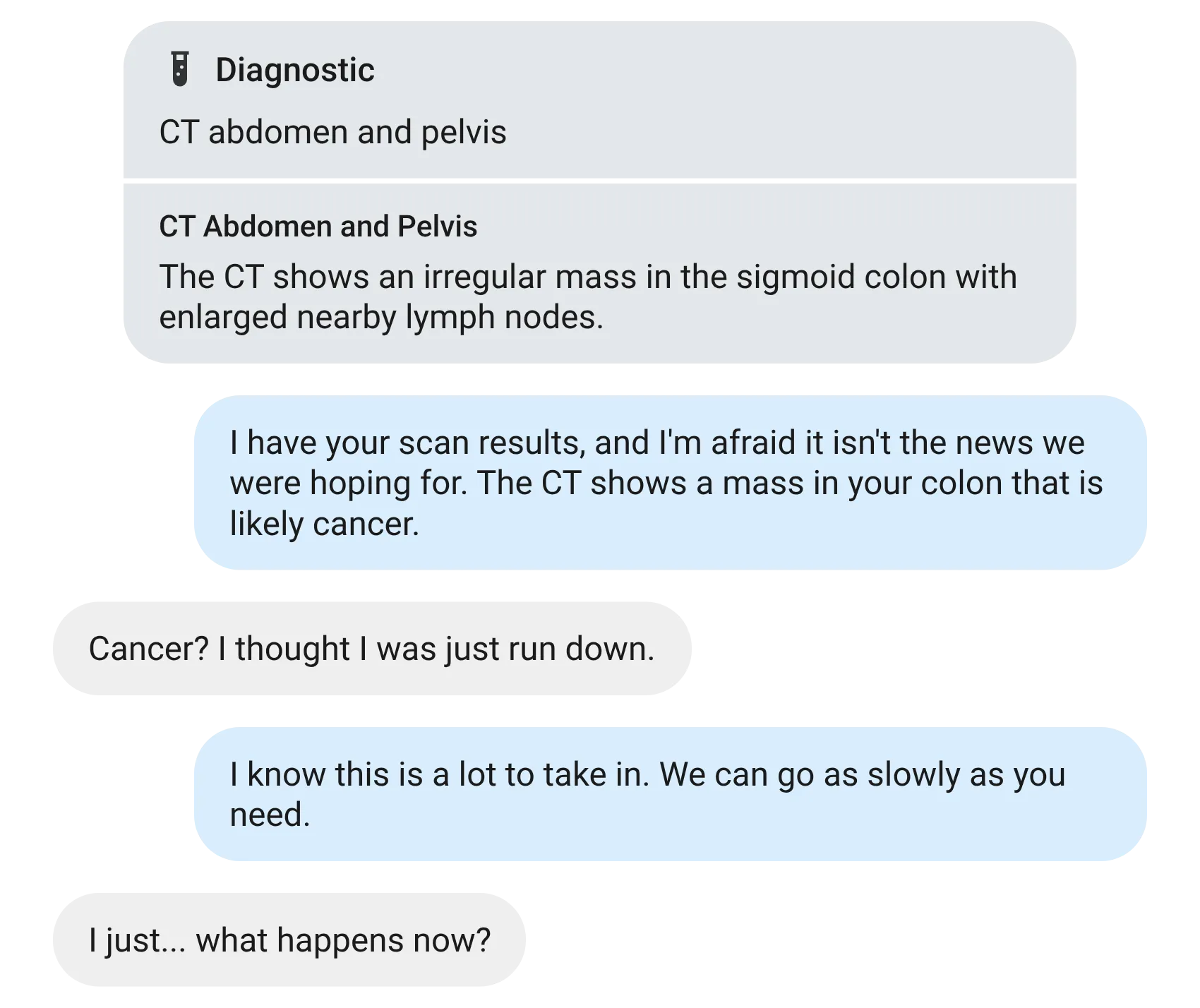
A case can have a conversational objective instead of, or on top of, a diagnosis. Learners can practice:
- Delivering bad news
- Disclosing a medical error
- Goals-of-care conversations
- Counseling and patient education
Build it as a standalone conversation, or as the final part of a larger case, so the learner who worked up the diagnosis is the one who has to share it.
Beyond the patient.
Parents, family & caregivers
The person answering can be someone other than the patient: a parent in a pediatric case, an adult child for a patient with dementia, or a caregiver who knows the history best.
Consults with the care team
Learners can consult members of the virtual care team during the encounter, practicing interprofessional communication through concise case presentations and focused clinical questions. What they ask also gives you insight into their reasoning and where their knowledge has gaps.
Students say it feels real.
"Some of the other patient simulation platforms I have tried have patients responding with medical terminology like the pain is in my upper right quadrant, that is not how real conversations go or how patients communicate with their providers."
"Simulating a physical exam and interpreting the results makes it a much more realistic, end-to-end patient encounter."
"Having to justify our reasoning and decisions with Sapient Clinician feels medically deeper than other AI patient simulation tools."